🧪 The History of Iodine in Medicine
How a chance discovery in 1811 became one of medicine's most versatile tools — saving millions of lives over two centuries
🔬 Discovery — Bernard Courtois, Paris
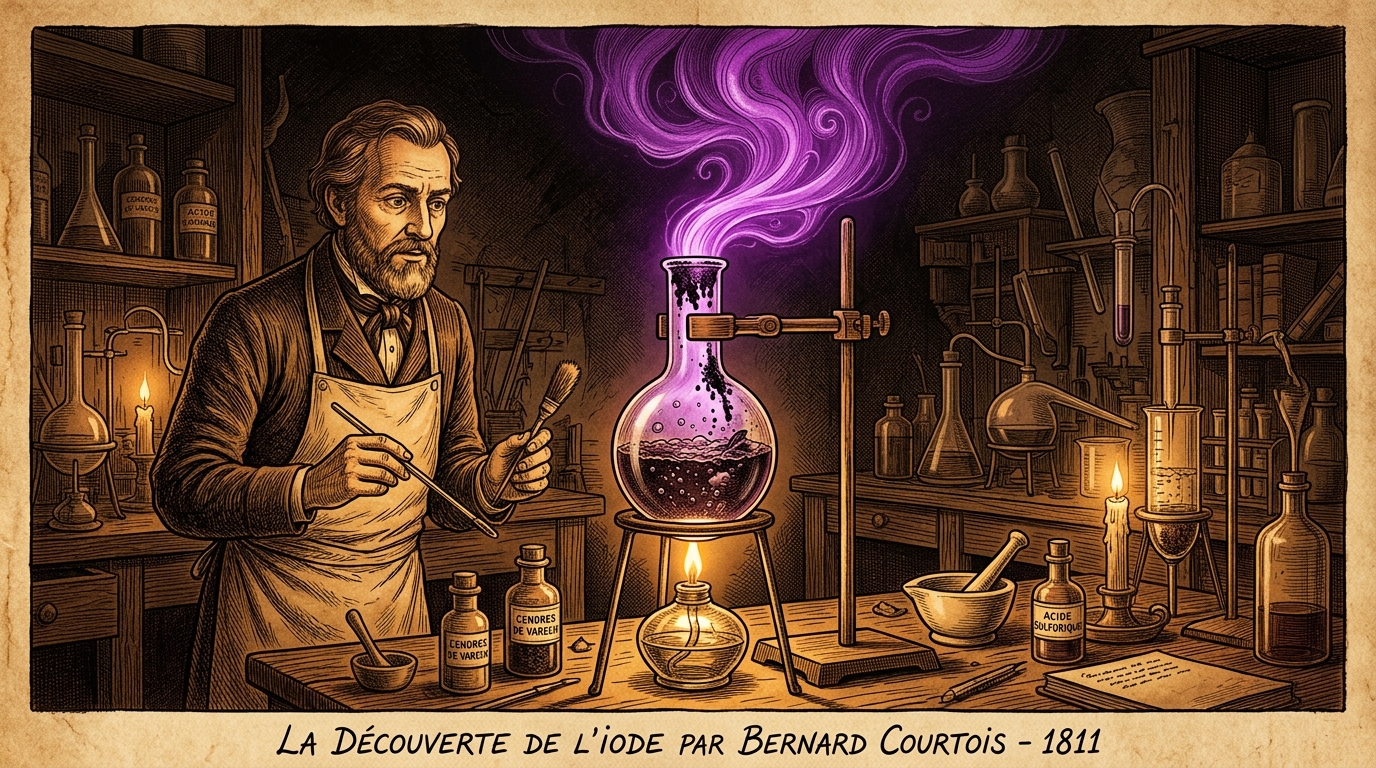
French chemist Bernard Courtois was extracting sodium and potassium from seaweed ash for saltpeter production. One day, he added too much sulfuric acid — and a striking violet vapor rose from the mixture, condensing into dark crystals. He had discovered a new element.
The vapor's color inspired the name: iodine — from the Greek ioeidēs (ἰοειδής), meaning "violet-colored."
🏥 First Medical Use
British physician Dr. John Davies first proposed using tincture of iodine as a wound treatment. He noted its remarkable ability to prevent wound infection and sepsis — a revolutionary idea at a time when post-surgical infection killed 30-50% of patients.
🦠 Lister's Antisepsis Revolution
Joseph Lister introduced carbolic acid (phenol) for surgical antisepsis, reducing surgical mortality from ~45% to ~15%. Iodine was soon recognized as an even more effective alternative — broader spectrum, less tissue damage, and more practical for field use.
🏨 Grossich's Method — Iodine Goes Mainstream
Croatian-Italian surgeon Antonio Grossich published his seminal paper in Zentralblatt für Chirurgie, demonstrating that tincture of iodine (iodine dissolved in alcohol) was the ideal preoperative skin antiseptic. His method was rapidly adopted across Europe and America.
Grossich's protocol was simple: paint the surgical site with 2-5% iodine tincture, allow it to dry, and proceed. No scrubbing needed. No secondary infections.
⚕️ World War I — Iodine Saves Millions
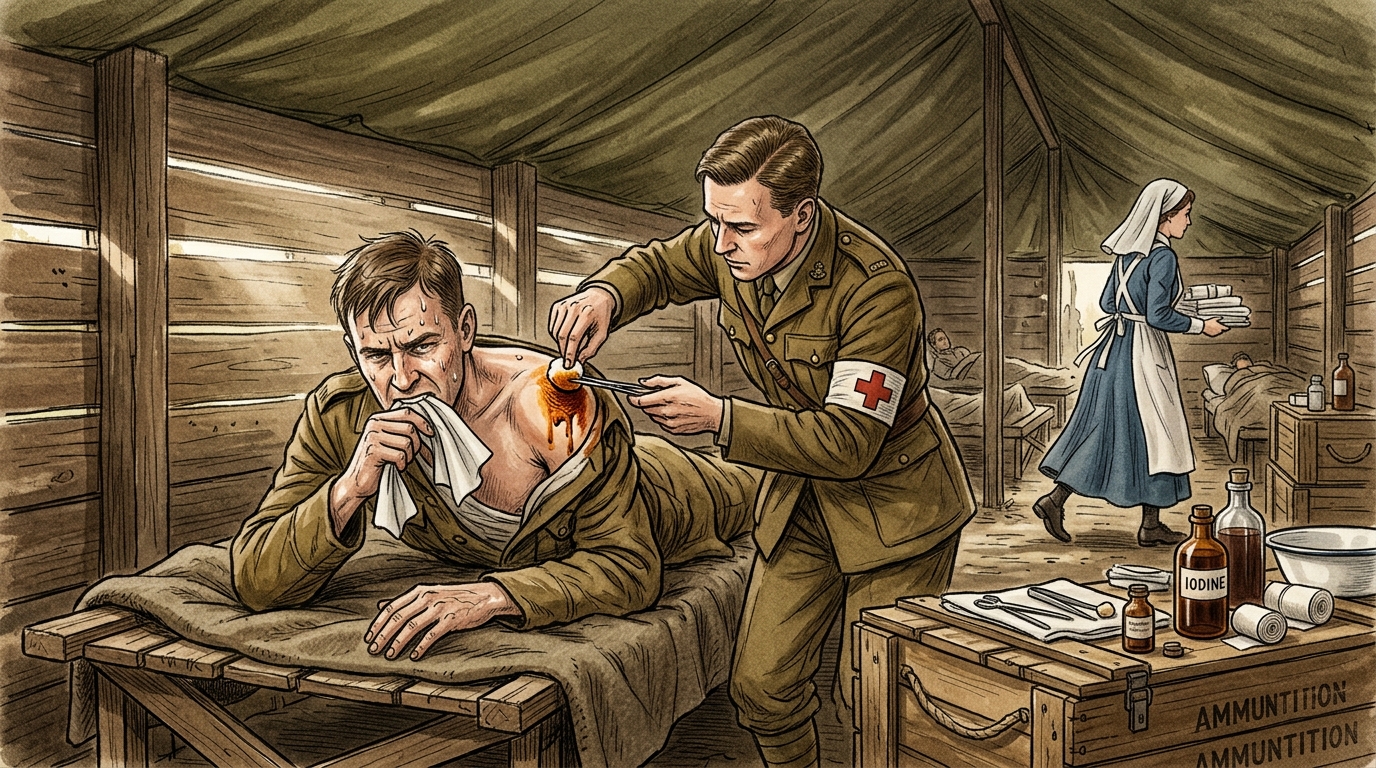
With millions of wounded soldiers and limited access to sterile facilities, iodine tincture became the most important antiseptic of the Great War. Field medics carried iodine ampoules to disinfect wounds immediately on the battlefield. It dramatically reduced the incidence of gas gangrene, sepsis, and amputation.
For the first time in history, a wounded soldier who reached a dressing station had a realistic chance of surviving without infection. Iodine was credited with saving hundreds of thousands of lives during this period.
🌍 World War II — Standard Issue
Iodine tincture was standard issue in every military first-aid kit of World War II. Its reliability, stability, and broad-spectrum activity made it the antiseptic of choice in every theater — from the jungles of the Pacific to the deserts of North Africa.
🧴 The Great Improvement — Povidone-Iodine (PVP-I)
The single most important advance: chemists Shelanski and others discovered that complexing iodine with polyvinylpyrrolidone (PVP) created a water-soluble, non-staining, less-irritating form of iodine — povidone-iodine.
Unlike iodine tincture (which contains alcohol and stings), PVP-I releases iodine slowly, providing sustained antimicrobial activity without tissue damage. Brand name: Betadine®.
💡 Why PVP-I is better for nail fungus
PVP-I releases free iodine gradually over hours — not all at once like alcohol-based tincture. This sustained release means a single application continues killing fungi for longer. It's also gentler on skin, making it suitable for daily use over many months.
🏛️ Iodine in Modern Surgery
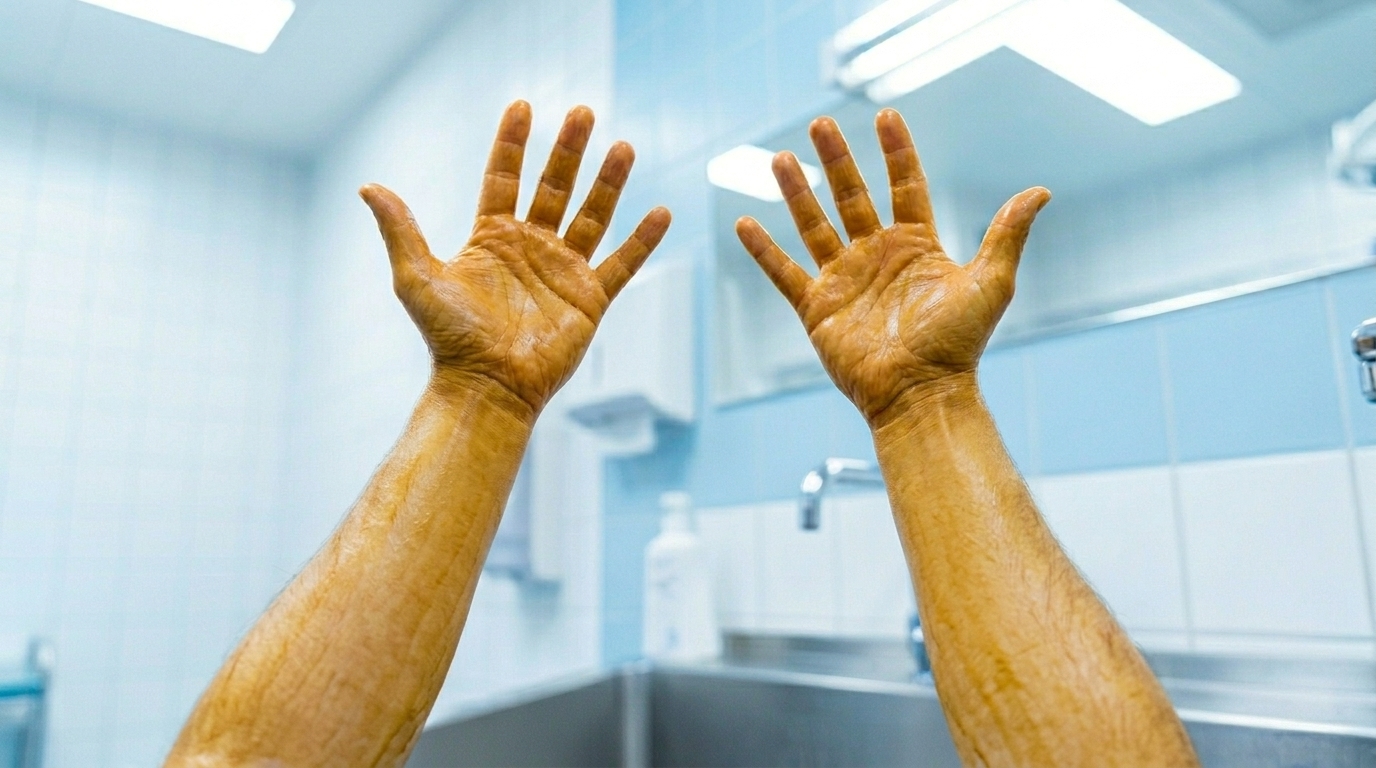
Povidone-iodine became the standard preoperative surgical scrub worldwide. Surgeons scrub their hands and forearms with 7.5% PVP-I solution for 2-5 minutes before every operation — a ritual repeated millions of times each year globally.
It is also used for:
- Preoperative skin preparation (painting the surgical site)
- Wound irrigation in emergency rooms
- Vaginal antisepsis before C-sections (reduces infection by 40-60%)
- Oral antiseptic mouthwashes
- Instrument disinfection
📄 CMAJ Case Report — The Birth of This Protocol
A retired physician published a letter in the Canadian Medical Association Journal describing how he cured his own toenail fungus with one drop of 2.5% iodine tincture daily. The total cost: $3.27. This single case report planted the seed for everything on this site.
🔬 Modern Research Confirms
A 2021 comparative study published in GMS Hygiene and Infection Control confirmed that povidone-iodine kills >99.99% of fungal pathogens within 30-60 seconds of contact, even when diluted. No other common antiseptic matched its combination of speed, breadth, and safety.
✅ Safety Profile
After 214 years of continuous medical use, iodine has one of the most thoroughly documented safety records of any antiseptic:
- No known microbial resistance — after a century of global use, no fungus or bacterium has developed resistance to iodine (unlike antibiotics and some antifungal drugs)
- Rare allergic reactions — iodine allergy exists but is uncommon; most "iodine allergies" are actually reactions to other ingredients or shellfish proteins (which are unrelated)
- Safe for long-term use — topical iodine on intact skin has minimal systemic absorption
- Caution — avoid on open wounds, thyroid conditions, pregnancy without medical advice
🦶 What This Means for Your Nail Fungus
The same iodine that surgeons have trusted for over a century, that saved millions of lives in two world wars, that kills 99.99% of fungi in seconds — is the same amber liquid you can buy at any pharmacy for a few dollars.
There is no mystery here. Only a story that hasn't been told.